This post contains a few affiliate links to relevant books.

Nellie Tayloe Ross made history as the first woman governor in the United States. She became Wyoming’s governor in 1925 after her husband, Governor William Ross, passed away. Nellie was a housewife left with debt and three sons to provide for. She was reluctant to accept the nomination but did so just 45 minutes before the deadline. She won, and actually had a much bigger victory than her husband.
Nellie Tayloe Ross believed in equal opportunity irrespective of gender. She was criticized by some for not being more concerned with gender and the women’s suffrage movement.
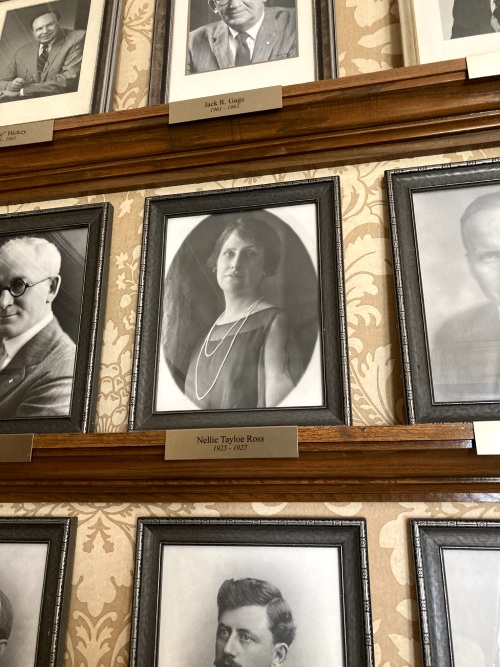
“The term “new woman” does not fall pleasantly upon my ears,” wrote Nellie in the late 1920’s, “for I do not think the so-called “new woman” is as new as she seems. She is merely adjusting herself to the changing conditions of a new era…What woman does want and all she wants, I think, is better to meet the responsibilities that are essentially hers as a woman and at the same time to have a chance to develop the faculties with which she as an individual has been endowed.” This quote is from the preface of Governor Lady by Teva Scheer. Nellie is recorded saying her highest calling was to be a mother, but was thrust into circumstances (her career).
“I’ve always thought candidates for public office should not be chosen on the basis of sex. Being a woman should not mitigate for or against someone” – Nellie Tayloe Ross
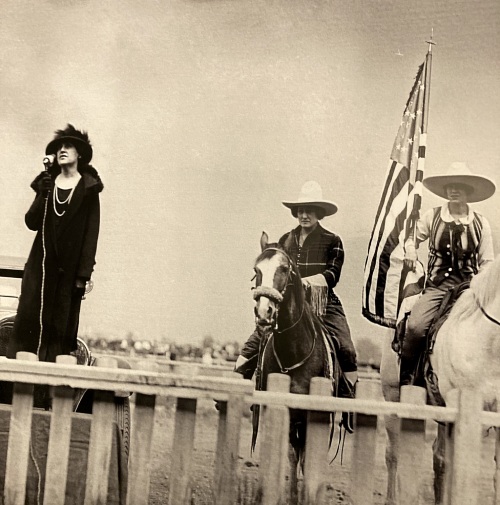
“Working-class women had always been present in the workforce, but when increasing numbers of upper- and middle-class women began to enter colleges and seek employment during the first decades of the twentieth century, many Americans became deeply concerned that women’s emergence from the home would defeminize them. Their exposure to the “immoral” public sphere would render them coarse and mannish and make it difficult if not impossible for these women to lead “normal” lives as wives and mothers.” Teva Scheer, author of Governor Lady wrote.
“I … do not represent the over-powering, masculine, militant type of ‘politician’ that violates their sense of what the Lord intended a woman should be,” Nellie noted in a handwritten narrative of the inaugural parade

Nellie ran for a second term but lost. She chose not to campaign when running for election initially. As a southern lady from Missouri, she may not have wanted to look overly ambitious as a woman seeking work outside of the home. She believed it is a woman’s business to help mold the human race. When running a second time, a newspaper publisher’s wife had it printed that Nellie failed to place a single woman to any office previously held by men. Nellie hardly played the gender card while promoting herself. She said “I would be Governor not because I am a woman, but because I have the ability to govern. The people of Wyoming have entrusted me with this office, and I shall carry out my duties faithfully.”
Nellie Tayloe Ross died in 1977 at the age of 101. The New York Times obituary said she was “ever feminine, never a feminist”. Nellie lived during such an interesting time. As southern woman whose mother’s family owned slaves, Nellie lived to witnessed the civil rights movement. Nellie Tayloe Ross was born just 100 years after the signing of the Declaration of Independence. Born during the year the telephone was invented, Nellie lived to see televisions in family homes. She lived during a time where a family would read to each other for entertainment as they gathered by a fire for warmth. This family intimacy is noted by historians to have been lost with modern heating, lighting, and television.
The Equality State
Wyoming had earned its nickname, “The Equality State,” for being the first to grant women the right to vote in 1869. In 1870, Amalia Post of Cheyenne became one of the first women to serve on a US jury. In 1894, Wyoming Superintendent of Public Instruction Estelle Reel was the first woman elected to statewide office. In 1920, women won the vote nationwide. Nellie Tayloe Ross was elected the first woman governor in the US four years later. Nellie later became the first female Director of the US Mint. Her 20-year term is the longest in the Mint’s history. Governor Lady mentions how delightful Nellie found Wyoming.
Taming Wyoming
The Wyoming cattle industry began in the 1860s. People had to improvise to survive this harsh land. Violent land disputes were fairly common in Wyoming largely due to conflicts between ranchers, homesteaders, and cattle barons. The chaotic nature of these disputes stemmed from competition over land and resources, especially as more settlers moved westward. Wyoming’s open, unregulated lands were prime for cattle grazing, but more settlers started claiming smaller plots of land for farming with the passage of the Homestead Act in the late 1800s. This led to clashes with large ranchers who relied on vast open ranges for grazing cattle. Some women were wrongly accused of crimes as others sought to take control of their land or property. One notable case was that of Ellen Watson, known as “Cattle Kate.” In the late 1880s, Watson was falsely accused of cattle rustling by wealthy ranchers who wanted her land. Despite there being little evidence, she and her partner were lynched without a trial. This was later revealed to be a land grab disguised as justice.

Wyoming’s justice system slowly developed, and the first prison in the state, the Wyoming Territorial Prison, opened in 1872 in Laramie. As the state’s legal system grew more robust in the 1900s courts began to offer fairer trials.

Wyoming in the 1920s had a population of just over 200,000 people, with much of the state still focused on agriculture, cattle ranching, and mining, particularly coal and oil. The economy boomed for a time, thanks to oil discoveries, and towns like Casper grew rapidly. However, much of Wyoming remained rural, with small towns spread across its vast landscapes.

It was a tough time to take office as many people fell to financial ruin. After the war, drought and depression gripped the state. Farms failed, ranches failed and banks failed.
The state was not immune to the national effects of Prohibition, which led to illegal bootlegging operations, and the economic disparity between wealthy oil barons and struggling farmers created tension. Nellie pushed continuation of William’s strong enforcement of Prohibition. Her strong stance on prohibition may have played a role in not being re-elected.
Nellie wrote telling her brother how surprisingly cool tempered she was as she fired two men hired by her husband. One was a game commissioner she charged with drunkenness and doing a poor job of handling the fishing license program. The other was the state’s law enforcement commissioner, who Nellie charged with drinking on the job, failing to enforce Prohibition, and taking protection money from bootleggers.
Nellie worked to stabilize the state through reforms. Her understanding of family struggle and financial ruin likely influenced her push for tax relief for the poor. Her mother’s family lost everything when their plantation was destroyed during the Civil War. They never recovered. Nellie watched as her father struggled to support the family through various jobs. She was a teacher before starting a family with her husband, whose family had also been financially devastated by war. She was raised to appreciate fine things but also witnessed how quickly those things could be lost. She worked to create policies that supported struggling families during her time as governor. Nellie supported state spending cuts, low-interest state loans for farmers and ranchers, and laws protecting children, women workers, and miners.
Nellie said it was surprising how many people thought the governor exercises dictatorial authority over the lives and property of citizens. She said they seemed to expect a governor to “move heaven and earth” to meet their desires.
Read about Nellie’s interesting life in Governor Lady for free with a kindle unlimited free trial.

Visit the Historic Governor’s Mansion in Cheyenne or the Wyoming Territorial Prison State Historic Site in Laramie, Wyoming to learn more about Wyoming’s history.



 Wyoming Prairie
Leave a reply to Ashley Cuevas Cancel reply